Obviously, the Bible has been translated into languages other than English. Jesus told his disciples to make disciples of all nations (Matt 28:18—20) and to be his witnesses to the ends of the earth (Acts 1:8). As contemporary missionaries continue those efforts, they need to be able to communicate with people in their language. What is the status of that translation effort? I’ve witnessed a few examples of that effort that I share below.
Overview
The Wycliffe Global Alliance coordinates the activities of over one hundred Bible translation organizations. They identify 7,396 living languages, of which 544 have no Bible translation at all. In 1999, there were 4,600 languages with no Scripture, so tremendous progress has been made in the last 25 years. There are 776 languages with a full Bible, with work in progress on 4,447 languages.
The Museum of the Bible in Washington DC has an “illumiNations” exhibit illustrating the progress being made to translate the Bible into all living languages.
A photo of the illumiNations exhibit at the Museum of the Bible. It is much more interesting than my poor photo portrays.
Believers have translated Scriptures continuously since ancient times. Some translations of the Old Testament predate Christ. Translations continue today. Below is a snapshot of translations that have impacted me, presented in chronological order.
Aramaic
Translations date back to before the New Testament. The earliest known translations were of Hebrew into Aramaic and are known as Targums. These were spoken translations in the 6th Century BC, around the time of the Babylonian Exile, with written forms appearing by the 1st Century BC. To the untrained eye, Hebrew and Aramaic look similar.
Greek
Around 300 BC, Ptolemy II, a Greek king of Egypt, commissioned seventy-two Jewish scholars to translate the Hebrew Scriptures into Koine Greek for Alexandria’s library. This became known as the Septuagint, after the seventy, or “LXX,” which is seventy in Latin. The dispersed, Hellenized Jews embraced this translation. Many of the quotations of the Old Testament in the New Testament use the Septuagint translation. Koine Greek was the common Greek spoken around the Mediterranean at this time and is the language of the New Testament. Koine Greek, Attic Greek (used in Classical Greek literature), and modern Greek are related but distinct. Some early translations used the Septuagint as their source text, and it continues to be used as a critical source for the Old Testament.
Latin
Evidence suggests that there were various “Old Latin” (Vetus Latina) translations of parts of the Bible in the 2nd Century AD, with the Septuagint used as the source for the Old Testament. In the fourth century AD, the Roman Catholic Church commissioned Jerome to translate the Bible into Latin. His work translated directly from Hebrew texts while building upon previous work using the Septuagint, and resulted in the Vulgate, the Roman Catholic Church’s official Bible for centuries.
Other Languages Including Ethiopic
In the first few centuries AD, the Bible was translated into a few other ancient languages. One notable example is Ethiopian, also known as Ge’ez. One of the three oldest Bibles in existence is the Ethiopian Bible from 330—350 AD. This Bible includes texts not found in other Christian Bibles, illustrating the tradition’s early divergence. It includes translations of some ancient Jewish literature, including the book of Enoch, which was written in Hebrew, but no complete Hebrew copy exists.
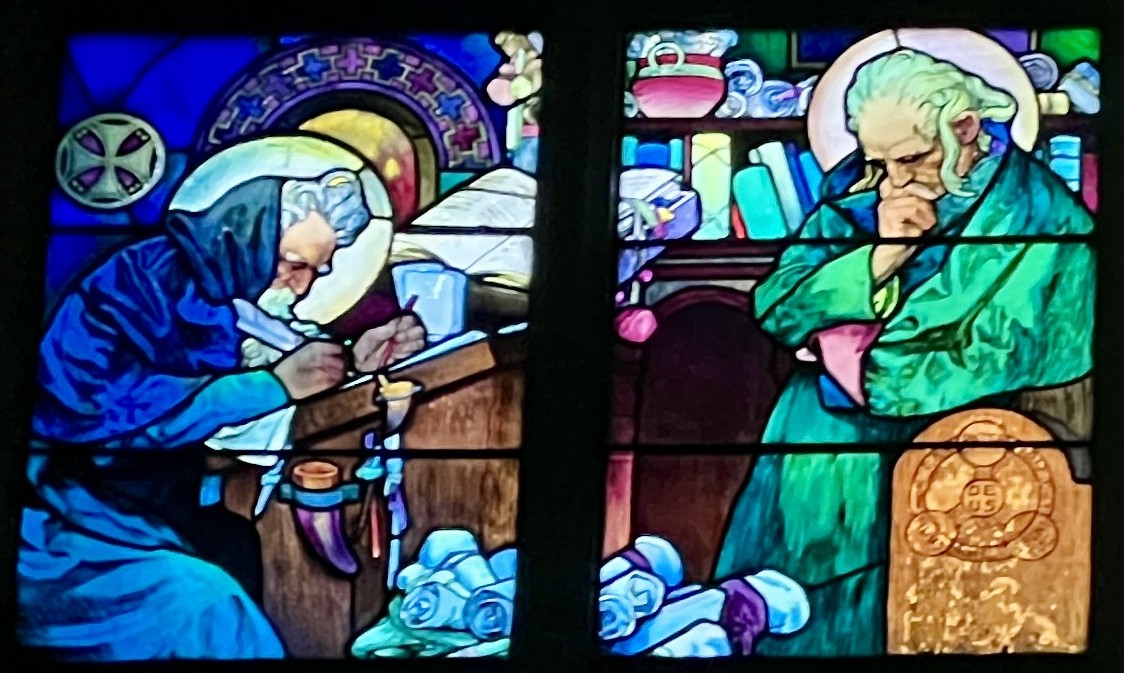
I was surprised to learn that one of the earliest Bible translations was Czech. In 865 AD, Cyril and Methodius brought Christianity to Prague from Thessaloniki. The Czechs had no written language, so Cyril created an alphabet to enable a written Bible in their language. Such a need to create a written form of a language to enable Bible translation continues today.
This stained glass window in Prague’s St. Vitus Cathedral shows Cyril and Methodius translating the Bible into Czech.
Cyril’s disciples evolved this language into a script that is used in over fifty languages throughout Eurasia, and was named the Cyrillic script to honor Cyril.
English
While there is evidence of translations into Old English dating back to Bede in 735 AD, Wycliffe created the first English translation of the whole Bible in 1388 from the Vulgate, with the first translation into English from the original languages performed by Tyndale around 1530. Tyndale used Erasmus’s printed Greek New Testament (see below), which led to the King James Version in 1611. On a side note, one of the earliest Bible translations was into Welsh in 1588, and it is credited with helping to save the language from dying.
Gutenberg’s Printing Press and the Fall of Constantinople
Two events in the 15th century significantly impacted Bible translation. First, in 1440, Johannes Gutenberg invented the printing press. The first book that he printed was the Vulgate.
Second, in 1453, the final major city in the Byzantine Holy Roman Empire, Constantinople (today’s Istanbul), was defeated by the Ottoman Empire. Christian scholars, with many ancient biblical texts, headed west to avoid the invading Islamists. The West’s focus on the Latin Vulgate had reduced its focus on biblical manuscripts in the original languages.
The renewed interest in the Bible in its original languages and the information revolution that the Gutenberg press enabled led to Erasmus creating the first printed edition of the Greek New Testament in 1516, the Novum Instrumentum Omne. He primarily used Byzantine texts, and his Greek New Testament complemented Hebrew Bibles that had been printed since the late 15th century. These books and the printing process gave access to the Bible in its original languages to many more translators.
German
Martin Luther completed his influential translation into German in 1534, leveraging other scholars to help with his translation from the original languages. Luther also used Erasmus’s Greek New Testament.
From Swahili to Spanish
I first saw a Bible in a non-English language during a visit to Kenya in 1992, when a market trader showed me her Swahili Bible. Since then, I have always been fascinated by how the biblical text looks in languages that use a different script from English, like Chinese or Korean. Sometimes I have been assisted by what is called a polyglot, which prints the text from two languages alongside each other. I helped a Christmas ministry distribute Bibles in English and Spanish, with the Spanish Bibles primarily for older Hispanic people who did not pick up English as easily as the youth.
I was blessed to witness some pioneering Bible translation when I worked in Africa in 1997. While living in Pointe Noire, Congo, I attended a church that had been established by some missionaries from North America. While Pastor Gary would preach in French, a visiting pastor might preach in Munukutuba, the local language, also known as Kituba. I must add that I barely understood French, let alone Munukutuba, so I read my English Bible! Another Belgian missionary in town, Jean-Pierre, was working on translating the Bible into Munukutuba. A written form of the language had been created, and Jean-Pierre was working on his second New Testament book.
In 2006, the Bible Society published Ngwisani Ya Malu-Malu, which means The New Testament in Munukutuba, and it is available here. The translation, called BNT or Kituba, is available on bible.com
Last month, our church announced that it was financially supporting the translation of the Bible into a South Asian language. The language was identified as Kechin, though this is a pseudonym to protect the translators involved, as there can be strong local resistance to such initiatives.
Arabic
Decades of study in the Middle East led Kenneth Bailey to write The Cross & the Prodigal: Luke 15 Through the Eyes of Middle Eastern Peasants. It is a fascinating insight into cultural symbolism in the narrative of the Prodigal Son, which is lost when read with Western eyes. Bailey argues that much of the first-century culture has been preserved in the Arabic way of life. In the book’s introduction, he points out that “There are more Arabic-speaking Christians in the Middle East than Jews in the entire world.” While Arabic speakers were present at Pentecost (Acts 2:11), Arabs are assumed to be Muslims, and little attention is given to Arabic translations of the Bible.
One example Bailey provides in Jesus Through Middle Eastern Eyes is the mistranslation of “inn” in Luke 2:7. Bailey explains that the word in the Arabic translation would definitely be a guest space, typically the upper room of a common village home, rather than a commercial establishment. However, I note that Bailey uses the RSV, which preserves the KJV’s usage of “inn,” while translations that started from the original languages, such as CSB and NIV, use “guest room.” The NET Bible, while using “inn,” provides detailed notes on the translation debate about this word.
Bailey’s books provide fascinating insight into how one’s culture influences one’s reading of the Scriptures, and I thoroughly recommend his books.
Other Non-Foreign Languages
The Bible Museum’s exhibits included a Bible in Braille. Wow! I have since learned that there are different forms of Braille for over 130 languages, with about 40 having a Bible in Braille. There are also over 300 distinct sign languages, with the complete Bible only in American Sign Language, and the BSL Bible Translation Project actively translating the Bible into British Sign Language. You can watch Mark’s Gospel below. I wish there were subtitles!
My research revealed that there are over one hundred translations of the Jehovah’s Witnesses’ English Bible, the New World Translation. This includes the first translation in American Sign Language. However, there is significant criticism about the New World Translation, with English words being chosen to reflect the denomination’s theological position rather than the original language. Also, there are concerns about the credentials of the translators, who have remained anonymous.
Reflection
The illumiNations alliance has the goal, “It’s fully expected that, in our lifetime, 100% of the world’s population will have access to a key portion of Scripture.” They aim to have some Scripture translated into all languages by 2033.
I introduced this post with Jesus’s instructions to make disciples of all nations (Matt 28:18—20) and to be his witnesses to the ends of the earth (Acts 1:8). Some translators are also motivated by Matthew 24:14, which states that the end will come after the Gospel has been proclaimed throughout the whole world. I do not have an opinion on whether translating the Bible into all languages will accelerate Jesus’s return. Nevertheless, I see the work as valuable, and I hope that you found this interesting!
What? There are mistakes in the Bible? Well, kind of…
This is the fourth post in a series that looks at how the Bible came from God to me. This post looks at some of the potential mistakes in today’s printed word.
Some who read this might react that there are no mistakes in the Bible. I believe the Bible is from God, and God does not make mistakes, yet some errors have crept in from when God inspired the writing of his inerrant Scriptures to when later generations have read his word. Below are my experiences.
The theology classes that I took introduced a concept known as biblical inerrancy, i.e., the Bible is without error. It helped me rationalize things I found in the Bible that did not appear completely truthful. Below is a brief and inadequate summary of my take on it.
The inerrancy applies to the original autographs, i.e., the documents that the biblical authors wrote. Our best manuscripts are copies, and errors were injected into the copying process. However, evidence suggests that such errors are minimal.
The inspired biblical authors wrote from their perspectives. God did not dictate the words to the authors, so the words are from the authors’ viewpoint and their use of language. For instance, Ecclesiastes 1:5a says, “The sun rises, and the sun goes down.” Arguably, this is incorrect because the Earth is rotating rather than the Sun going up and down. However, such terminology continues to be used today, as it is from our perspective.
The Bible was written in certain styles, known as literary genres. It is not an encyclopedia with a list of facts. For example, when Mark wrote, “And those who ate the loaves were five thousand men” (Mark 6:44), he did not intend to imply that there were exactly five thousand men.
The Bible appears to have contradictions, with one part disagreeing with another. Examples are found in the Gospel accounts where the four narratives don’t agree. Such eyewitness accounts are known to describe things differently. An example is the descriptions of who was present with Mary Magdalene at the discovery of the empty tomb. Each narrative mentions different people, as each author wished to describe the scene differently. I examined this more in this paper on apparent contradictions in the Gospels for my theology class.
The Bible disagrees with science. People struggle to reconcile what the Bible says in Genesis 1—2 about creation and what science suggests. I believe both, even if they disagree, and that takes faith. I accept that there are things that I don’t understand. Regarding creation, I am open to the concept that it was not six twenty-four-hour periods, and I was happy to read about multiple evangelical positions about this in Reading Genesis 1—2: An Evangelical Conversation, which presents five views on interpreting this passage from evangelical Christians. My main takeaway is that the purpose of Genesis 1—2 is to explain that the omnipotent God created the heavens and the earth, in contrast to other gods that ancient civilizations believed in. The creation account’s intent is not to provide a detailed scientific explanation about how God did it.
Now, to mistakes. This first one is brilliant!
Moses with Horns in the 4th Century Vulgate Translation
A visit to the St. Peter in Chains church in Rome reveals a fascinating translation error. The church houses Michelangelo’s Moses, a sculpture from 1515, and shows Moses with horns. Michelangelo used the Latin Vulgate as his Bible which describes Moses as descending from meeting God on Mount Sinai “with horns” (Latin: cornata) (Exodus 34:29). The Hebrew word is “qâran” translated as “radiant” in today’s English Bibles, but it is similar to “qérén” which means “horned”, which led to the Vulgate’s mistranslation. The Vulgate’s mistranslation is reflected in the English Douay-Rheims translation from the Vulgate, which translates Exodus 34:29 as, “And when Moses came down from the mount Sinai, he held the two tables of the testimony: and he knew not that his face was horned from the conversation of the Lord.” It is even reflected in Wycliffe’s Bible, the first English translation from 1388, because Wycliffe translated from the Vulgate.
Michelangelo sculpted Moses with horns in 1515 because of the Vulgate’s mistranslation of the Hebrew into Latin.
Errors in Manuscripts
As discussed in previous posts in this series, the Bible we have comes from manuscripts that are copies of previous manuscripts. The earliest version of the Bible in existence today, a Latin translation called the Vulgate, used one set of New Testament manuscripts, known as Western text-type. The King James Version used another set, known as the Byzantine text-type, which were considered to be a more accurate representation of the original documents. Modern New Testament translations are largely based on the manuscripts of the Alexandrian text-type, which scholars assess as being more accurate than the Byzantine texts. What sort of differences are there?
The King James Version (KJV) includes some verses that are not found in the Alexandrian text-type manuscript, and scholars believe they were added through the copying process. The Alexandrian manuscripts do not include sixteen verses (e.g., Matt 17:21, Mark 7:16, Acts 8:37, Romans 16:24) and omit several other partial verses.
An example of a partial omission is from the Lord’s Prayer in Matthew 6:13. I remember learning the “longer” version of the prayer, which includes the phrase, “For Thine is the Kingdom, and the power and the glory for ever. Amen.” This phrase is in the King James Version, and related Bibles, because it was in the Byzantine manuscripts. When I was young, this was the only translation available. However, it is not in translations like ESV or CSB, because it is not present in the Alexandrian manuscripts, though they include a footnote. Such a phrase is known as a “doxology,” and while there is nothing wrong with it, it probably was not in the original biblical text that Matthew wrote. Indeed, our church recently led the congregation through the KJV’s version of the Lord’s Prayer, and it is the version that anyone over a certain age memorized.
The KJV includes two passages that continue to appear in modern translations, but with a footnote indicating that scholars believe that they were not part of the original text of the Gospels. The passages are Mark 16:9—20 (an alternative ending to the Gospel) and John 7:53—8:11 (the narrative about the adulterous woman).
I accept that better manuscripts might be discovered that lead to a “better” New Testament text. This happened to the Old Testament with the discovery of the Dead Sea Scrolls in 1946. For instance, some translations, such as CSB and NIV, include “light” in Isaiah 53:11, which was in the Dead Sea Scrolls but not the main manuscript used for translation (the Masoretic Text). The ESV omits “light,” but all of these translations include a footnote.
The variations between these manuscripts are very small, nearly insignificant, and do not affect the Bible’s overall message. I recognize that calling these differences in the KJV “errors” is strong. However, this does not mean the KJV is bad, and there can be value in leveraging this traditional translation. After all, no translation is as accurate as the original Hebrew or Greek, but we don’t read those in our churches!
The He and She Copies of the 1611 King James Version
The first printed edition of the King James Bible in 1611 had some printing errors. One prominent one was in Ruth 3:15. The earliest edition reads, “and he went into the city,” while subsequent editions read, “and she went into the city.”
However, there is variation between extant manuscripts on whether this word should be a “he” or a “she,” with NIV and NET choosing “he” and CSB, ESV, and NASB choosing “she.” These five translations of this verse are compared here.
The 1631 Wicked Bible
A misprint led to a rendering of Exodus 20:14 as “Thou shalt commit adultery.” The publisher was fined £300 and lost their licence. A copy of this Bible is on display in the Bible Museum in Washington DC.
Another misprint from 1795 led to the unfortunate printing of Mark 7:27 as “let the children first be killed” instead of “filled.” A copy of this book is also on display at the Museum of the Bible.
In this Bible, Mark 7:27 reads, “But Jesus said unto her, Let the children first be killed.” Picture taken from The Museum of the Bible’s Facebook page.
The Book of Eekiel in My 1995 Bible
I can’t remember finding a misprint in the body text in a Bible. However, I did find this error in my NASB Bible. It occurred just once.
A misprint in my Bible.
The Under Rower
An obituary on billgraham.org recalls John MacArthur’s teaching on the topic of being a servant. MacArthur had said, “I just really want to be known as someone who was a servant of the Lord. You know, Paul uses the word hupēretēs, a galley slave, under rower.” The context comes from 1 Corinthians 4:1, where Paul describes himself using this term. The Greek word looks like the combination of words for “under” and “rower.” I heard the pastor at my former church preach on the same concept, and there are many online articles about how “under rowers” reflect Christ’s servant.
In his book Exegetical Fallacies, D. A. Carson notes that R. C. Trench popularized this view in 1854. However, Carson uses this as an example of what he calls the root fallacy. Carson writes,
to derive the meaning of ὑπηρέτης (hypēretēs) from ὑπό (hypo) and ἐρέτης (eretēs) is no more intrinsically realistic than deriving the meaning of “butterfly” from “butter” and “fly,” or the meaning of “pineapple” from “pine” and “apple.” Even those of us who have never been to Hawaii recognize that pineapples are not a special kind of apple that grows on pines.
I was unable to find a published Bible translation that used “under rower.” However, it appears that even learned preachers are misinterpreting the Greek and introducing a meaning that was not intended by the author, especially when it makes great preaching fodder!
The Python Woman
A visit to Greece, following in Paul’s footsteps, revealed how translators have chosen to simplify texts to make them understandable. In the second half of Acts 16, Luke describes Paul being thrown in jail in Philippi because he commanded an evil spirit to come out of a girl. All major versions describe the slave girl in Acts 16:16 as having a spirit of divination or the ability to predict the future.
However, the Greek word used to describe this spirit translates literally as “Python.”
Luke’s contemporaries would likely have understood this as a link to the Oracle of Delphi, who was believed to predict the future when speaking in a trance caused by fumes at Delphi. In Greek mythology, the site at Delphi was guarded by Python, a monstrous serpent, which Apollo killed and established his own priestess called Pythia.
A literal translation of “Python” in English would be confusing. While this is not an error, it highlights the challenge of retaining all of the original meaning when translating into a receptor language.
Reflection
In my introductory post on this site, I described how I used to take the Bible “with a pinch of salt.” I thought there were lots of inconsistencies, contradictions, and errors in the Bible, which effectively allowed me to pick and choose what I wanted. While I subsequently accepted the whole Bible’s truth by faith, my academic Bible courses and travel to biblical lands have convinced my brain that these supposed “errors” are not errors at all. Above, I outlined some of the more unfortunate errors, which I find amusing, but help make it real. However, aligning the Bible with modern science remains a challenge, and I accept that an element of faith is required to accept both.
How has the Bible come to me from God? This is the third post in a series that looks at the background and history of translating the biblical text into English. This builds on my first two posts in the series, Where Did My Bible Come From?, which examined the flow of the text from manuscripts into today’s printed form, and How Did My English Bible Translation Come Into Existence? which explored the history of Bible translations.
I am blessed with ready access to dozens of English Bible translations. Biblegateway.com includes 64 English translations, and Bible.com and the Bible App offer 166 English translations. My preferred translation has evolved over the last few years, generally aligning with the church that I was attending.
I found fifteen Bibles in our house in seven translations. I review them below by age.
King James Version (KJV)
The oldest Bible that we have belonged to my father’s mother, Florence Williams. It was presented to her in 1912 as “First Prize for Regular Attendance” at Holy Trinity Sunday School in Richmond Upon Thames when she was thirteen years old. It does not state its version, but the phrase, “Appointed to be read in churches,” on its front page, indicates it is KJV. Cambridge University Press printed it, though there is no date.
I also have a Bible presented to my mother’s father, Frederick York Blanksby, at Easter on April 3rd, 1915, from his mother when he was eighteen years old. This was printed in 1914 by Cambridge University Press.
We also have a Bible that belonged to Nellie Lengefeld, Janet’s grandmother. It is a New Scofield Reference Bible, printed in 1967 by Oxford University Press in New York. The title page includes the comment, “Authorized King James Version. With introductions, annotations, subject chain references, and such word changes in the text as will help the reader.” It is a study Bible, created by Cyrus Scofield in 1907. As well as interpretive notes, it modernized some of the KJV text, and used the American spelling of words, for example, Joseph’s “coat of many colors” in Genesis 37:3.
Janet’s first Bible was a KJV and was given to her by her grandparents on her fourth birthday in 1970. It was printed by the World Publishing Company in Cleveland, Ohio. It uses Anglicized spelling (e.g., colours in Gen 37:3). It is a “self-pronouncing edition,” meaning that it included pronunciation guides for difficult words.
Janet’s well-used Bible
These KJV Bibles reflect the translation’s popularity, even after the publication of the English Revised Version in 1885, the American Standard Version in 1901, and the Revised Standard Version in 1952. The KJV is a word-for-word rather than thought-for-thought translation. Today, I generally don’t read the KJV because its New Testament’s textual basis was the Byzantine text-type, and the manuscripts based on the Alexandrian text-type, which most other translations use, are seen as closer to what the biblical authors wrote. Also, other translations are easier to read. However, the differences between the KJV and these other translations are not doctrinally significant.
Also, until about 1980, the KJV was the English translation used by the vast majority. Anyone who learned Bible verses “back then” most certainly would have learned from the KJV. Recently, our church used the KJV version of the Lord’s Prayer. There is nothing wrong with using the KJV! I strongly disagree with anyone who insists that the KJV is the only acceptable translation, as such a conclusion is flawed.
New King James Bible (NKJV)
In 1995, Janet was given an 1985 edition of this translation, and it included Precious Moments artwork by Samuel J. Butcher. It is in a lot better condition than the KJV Bible that was given to her on her fourth birthday in 1970. Janet avoided using it to keep it in good condition.
This Bible was more of an ornament than a book to read.
Over one hundred scholars worked on the NKJV. They updated the archaic language of the KJV while retaining its purity and stylistic beauty. It is less literal than the KJV. It also adds scholarly footnotes to highlight disputed verses from the KJV, for example, those found in the Byzantine manuscripts but not in the Alexandrian ones. I generally don’t use the NKJV.
New International Version (NIV)
I found five NIV Bibles. The oldest is the first Bible that I bought, which is a 1987 edition by Hodder and Stoughton in London. While it does not state that it is the Anglicized version, I can tell that it is because Genesis 30:32 says, “every dark-coloured lamb.” Genesis 37:3 was not useful as it describes Joseph’s coat as “a richly ornamented robe.”
I needed tape to hold my first Bible together.
In 1996, I purchased a chronological Bible based on the NIV, published in 1994. A chronological Bible presents all of the biblical text in its order of occurrence to assist with understanding the overall narrative.
This chronological Bible helped me read all the way through.
Janet and I gave each other Bibles at our wedding in 1998. These were published by Broadman and Holman from Nashville, Tennessee, in 1986. These use the standard, Americanized text of the NIV, as shown by Genesis 30:32, which says, “every dark-colored lamb.”
This was the first thing that had Janet’s married name on!
For Christmas in 1999, I gave Janet the Two-Year Daily Reading & Prayer Bible, published in 1997. This Bible rearranged the NIV text into daily readings to guide reading through the whole Bible.
This Bible helped Janet read through.
Finally, Janet gave me The Leadership Bible for Easter in 2002. This study Bible leverages the biblical text to examine leadership principles and to help the reader develop biblical leadership principles.
These five Bibles use the 1984 NIV translation, which is a small modification of the 1978 translation. Over one hundred scholars from five countries and over fifteen denominations worked on the translation from the best available Hebrew, Aramaic, and Greek texts. It is more of a thought-for-thought translation than a word-for-word one. Five hundred million copies of the NIV have been sold, and it has been the best-selling English-language Bible, but that is changing for multiple reasons. Mark Strauss discusses it here.
New American Standard Bible (NASB)
Janet and I switched to this Bible in 2012 when we moved back to the US and joined a church that predominantly used this translation. We each used a 1995 edition, published in a “take note” format with wide margins.
Janet wrote many notes in her Bible.
The NASB built upon the KJV and its revised American Standard Version, and incorporated recent discoveries of Hebrew and Greek textual sources in this translation using modern English. It is a word-for-word translation and complements those that are more thought-for-thought.
The Message Bible (MSG)
Janet purchased The Daily Message: Through the Bible in One Year to help her read through the whole Bible. Each day, the book presents a section of biblical text followed by a section from Psalms, Proverbs, or Isaiah and a couple of thought-provoking questions. Eugene Peterson, a pastor, translated the Message Bible from the original languages to create a highly-readable version.
The Message Bible provided Janet with a fresh perspective on the Scriptures.
I view the Message as a paraphrase rather than a translation. This, coupled with the fact that a single person did the translating, makes me consider this a commentary. It is unclear which original language texts Peterson used. The target language was idiomatic American English. For instance, his paraphrase of Romans 8:3—4 includes the phrase “The law always ended up being used as a Band-Aid on sin instead of a deep healing of it.” Band-Aid is a North American brand that I was not familiar with when growing up in the UK, knowing them as plasters. I have rarely used The Message.
English Standard Version (ESV)
Both Janet and I use an ESV Bible for daily reading and church. We each have a 2016 edition, published by Crossway, with wide margins for taking notes. We find that people often preach or teach using this version, and both of us have followed read-through-the-Bible plans that reference the ESV.
Over one hundred international scholars from multiple denominations worked on the ESV, which aims to be a literal, word-for-word translation. It built upon the legacy of the KJV, Tyndale’s original translation, and subsequent revisions, including the Revised Standard Version (RSV). The translators used the best available copies of the Scriptures in their original languages as input. This video provides fascinating insight into a debate in the translation process.
My Preferences and Why
I do not have a strong preference for a particular translation. I like to use the same translation as those around me, so that we can be on the same page. When someone else is reading a passage out loud, I dislike reading a different translation and trying to align what I hear with what I read. I find the Bible App on my phone invaluable as I can quickly bring up the version that someone else is reading from. It bugs me a little when people do not identify which version they are using because I then struggle to work out which one to follow along with! In my circles, I find people typically read from ESV, CSB, NIV, or NASB.
For personal Bible reading, I currently use the ESV, having previously read the NIV and NASB, and they are all good. For deeper study, I have learned that comparing multiple translations is key. When doing such a comparison, it is important to understand the version’s textual basis and translation philosophy.
Translation Textual Basis
The textual basis of a translation is the collection of manuscripts in ancient languages that were used to base the translation on. Below is a summary chart for the New Testament.
As the chart shows, the Western text has not been used for centuries. The Byzantine text-type was used for the KJV. The Alexandrian text-type includes manuscripts that scholars have determined are older than the Byzantine and are closer to the original documents. With this in mind, I prefer those translations based on the critical text, which prioritizes the Alexandrian text.
For the Old Testament, there is less variation. Most translations are based on the Masoretic Text, found in the Leningrad Codex. Other texts, including the Dead Sea Scrolls, introduce possible variants. Translations that use the Critical Text for the New Testament take a similar approach to the Old Testament, using the best representation of the original documents.
Translation Philosophy
When converting text from one language to a receptor language, the translator must find a balance between a word-for-word translation, sometimes referred to as formally equivalent or literal, and a thought-for-thought approach, often referred to as dynamically equivalent. Word-for-word is considered more accurate, while thought-for-thought is more understandable. An extreme thought-for-thought is a paraphrase. Below is an example of an assessment of where each translation lies on this spectrum. The translator’s interpretation of the text has a greater input as one moves to the right of this spectrum.
Thus, it helps to compare multiple translations when looking at a passage. My primary comparison would be between NASB, ESV, CSB, and NIV. Numerous scholars have been involved in each one. Examining a KJV/NKJV or NRSV text might apply in certain circumstances. Looking at text from a more dynamic translation would provide insight into the interpretation of its translator(s). Biblegateway.com readily enables comparing up to four translations.
The 2017 Christian Standard Bible argues that it has found the best balance between literalness and readability, describing its translation philosophy as “Optimal Equivalence.”
Many people in my circle believe that it is appropriate to capitalize pronouns that refer to God or Jesus. This was the practice that I followed until I started my studies at Liberty University, which did not capitalize. NASB and NKJV are examples of the few Bibles that follow the practice of capitalization, while the old English translations (from Wycliffe to KJV), and modern translations such as ESV and CSB, do not capitalize.
There was no capitalization in the original manuscripts. Pronoun capitalization was introduced in the late 19th-century to show respect. Choosing to capitalize is itself an interpretation of what the pronoun refers to. Through my studies, I got into the habit of not capitalizing such pronouns. I think this is the correct approach, but I have no issue if people wish to capitalize as their show of respect. I liked this blog on the topic.
Gender-Neutrality
Starting in the 1970s, feminist movements petitioned for language to be gender neutral, removing an implied gender when such a meaning is not intended. In translation, mapping words often involves such challenges. I remember my confusion when I first learned that a French table was feminine! Bible translators faced this challenge with words that were literally “man” but meant human beings, or that literally meant “brothers,” but their meaning was not singling out males.
Some translations are more gender-neutral than others, and this has led to criticism and controversy. For example, the NRSV is one of the most gender-neutral translations and includes other liberal positions in the English words it chooses. Updated NIV translations have been embroiled in similar criticism, which Mark Strauss discusses here. However, even the conservative CSB translation uses some gender-neutral language when the translators believed that was the author’s intent.
Gender-neutrality in the Bible has not bothered me, but perhaps I have not been significantly exposed to it. I remember one time, when Janet and I were visiting a church, that the opening prayer was “to God, our father and mother,” which made us quite uncomfortable. However, the way certain terms are translated, for example, by the NRSV, is central to doctrinal positions supporting homosexuality. My men’s Bible study group has spent many weeks examining both sides of this argument, and I remain convinced the Bible identifies homosexuality as a sin, along with many other sins.
Bibles With Notes
I see the value of study Bibles that include notes about the text. By their nature, these will tend to involve an interpretation by the author, which can add clarity to the text. I have little experience with study Bibles.
Each Bible has footnotes that provide additional information, with the New English Translation (NET) Bible standing out with over 60,000 translation footnotes. The NET started from the original languages, and its translation philosophy is similar to the NIV. I often use the NET’s footnotes as my initial investigation into a text.
The NET Bible’s footnotes provide a lot more information than other Bibles.
An Example from My Dissertation
For my dissertation, I examined what the Old Testament said about non-Jews. In ancient times, countries were less defined so concepts such as “foreign” were less clear. The term “gentile” did not take hold until after the Old Testament. The Old Testament authors used many different words to depict non-Jews, and each with different meaning. For example, in Exodus, the Hebrew word “ger” refers to a foreigner who was interested in Judaism, “nokri” or “nekar” was a foreign enemy, and “tosab” was neutral. The table below compares these three words used in Exodus 12 for non-Israelites, and how different translations handle them.
Translations from five versions of nēkār, tôšāb, and gēr in Exodus 12:43–48, from my dissertation.
The standard resources for detailed examination of biblical words are a couple of lexicons. For the Old Testament, it is The Enhanced Brown-Driver-Briggs Hebrew and English Lexicon, published in 1977, and known as BDB. For the New Testament, it is Greek-English Lexicon of the New Testament and Other Early Christian Literature, whose third edition was published in 2000, and is known as BDAG. However, comparing multiple translations is a revealing first step, accessible to all.
One section of the second chapter of my dissertation is titled “Terminology for Foreigners in the Hebrew Bible” (pages 36—45). Below is my summary.
Summary of Hebrew Bible Terminology for Foreigners
The words above refer either to groups of people (ʿam and gôy) or individuals (nokrî, zār,gēr,tôšāb, and ʿārēl). One must be careful when using the word “foreign,” which we associate with coming from a different nation today. Nationhood during biblical times differed from today. The common thread among the terms for “foreign” is that they describe those outside of the ingroup (i.e., Israel) defined ethnically and religiously. It also appears that a non-Israelite individual could choose whether they were a nokrî, zār,gēr,tôšāb, or ʿārēl, with Israel differing their approaches to each category.
This study highlighted the challenges of translating between languages that were used in such different cultures. This emphasized the challenges that this video shows that the ESV translators had in translating words around slavery.
Digital Resources
With the Bible App on my phone, I have access to more Bibles than I can think of. Listening to their audio Bibles adds a new dimension to Bible study. On a computer, I find biblegateway.com a valuable resource with lots of Bibles and comparison functionality. The blueletterbible.org and biblehub.com sites have useful tools for digging deeper.
For my academic studies, I initially used a free version of Logos Bible Software, including its app. After a few semesters, I upgraded to a paid package, but the free version has some useful features, including an interlinear. There is an online interlinear at https://biblehub.com/interlinear/. However, I must share the warning I was given about delving into the original biblical languages. A little knowledge about languages can be quite dangerous, as it can lead to incorrect conclusions. Humility is key, and my little knowledge has made me appreciate the tremendous value added by the scores of scholars who provide input into mainstream Bible translations. However, structured learning of ancient Hebrew or Greek is eye-opening while exhausting.
I do not have much experience with whole-Bible commentaries though Matthew Henry and Enduring Word look like good places to start, complementing the websites mentioned above. I would advise looking at more than one commentary so that you get multiple perspectives. I have found the overview-videos by The Bible Project to be valuable in explaining each book’s bigger picture and highly recommend these.
For deeper study, I always consult the Best Commentaries website. It uses an objective measure, and I recommend that you scroll past their “top three” to see more choices and determine whether you prefer an older or newer commentary, how technical you want it, and whether it is from a series you have liked, though not all commentaries in the same series are necessarily similar. Having found a book’s title, archive.org is an excellent online resource to check it out, though it only has older books, which might be earlier editions of current books. When purchasing, I have saved significant amounts by buying used copies of books from online retailers.
I don’t believe there is one best English translation of the Bible. The best Bible depends on the individual, their circumstances, and their application, and, in practice, is the one that is read the most.
My experience above showed that the KJV was still the prevalent translation until the late twentieth century, and many might have memorized Scripture from this version. For centuries, the KJV was the foundation of many Christians’ faith. At church this morning, our Bible study teacher played this clip from A Charlie Brown Christmas, where Linus recites Luke 2:8—14. This was made in 1965 using the KJV and remains a classic.
My daughter explained she used an NASB in Middle School, an NIV in High School, and currently uses an ESV. She found the NASB easier to read than the NIV, which is opposite to what the readability chart above suggests. She chose her ESV Bible because it had a pretty cover, but acknowledged it worked well because her church used it.
While our daughter chose this Bible for its pretty cover, it is filled with notes and highlights.
I have seen people using multiple translations in their argument, sometimes choosing one translation over another, but another translation elsewhere. I treat such positions with caution, as the preference might be to help support their argument, rather than a better reflection of the Scripture’s meaning. However, such a position can also be valid with the complex nuances of translation and source texts. For example, in Romans 1:3, translations such as ESV use the phrase, “according to the flesh.” Elsewhere in Romans, Paul uses the Greek sarx, for flesh, to describe humanity’s sinful ways. However, in Romans 1:3, Paul uses it to describe Jesus. The NIV translates this verse as “earthly life,” which I believe is a good interpretation, and illustrates a translation nuance.
My research for this article has identified the New Living Translation (NLT) as a responsible thought-for-thought translation by ninety scholars, avoiding paraphrase, and appropriate for children.
My default choice for the best Bible would be the one my church or Bible study teacher uses. Beyond that, I’d choose ESV, CSB, or NIV. For those who wanted to dig into English Bible translations, I hope that this discussion has shed some light on the differences between English Bibles.
How has the Bible come to me from God? This is the second post in a series that looks at the background and history of translating the biblical text into English. This builds on my first post in the series, Where Did My Bible Come From?, which examined the flow of the text from manuscripts into today’s printed form.
Since the Bible texts were first written, scholars have been translating them into other languages. In 2025, the Wycliffe Global Alliance identified complete Bibles in 776 languages. Their experts estimate that over 7,000 living languages exist, with 99% of people having access to some biblical Scripture in their native language. Bible Gateway provides over 200 versions in more than 70 languages, with 64 English translations, 19 Spanish translations, and 13 Chinese translations. Below the following summary table, I describe the most significant steps in the translation of the Bible into English.
Manuscript fragments of this translation of the Old Testament into Koine Greek date back to the 2nd Century BC. Koine Greek was a simplified form of Greek that was the common language of the Mediterranean and Middle East from 300 BC to 500 AD, after Alexander the Great’s conquests. Relatively complete manuscripts of the Septuagint include the 4th-century AD Codex Vaticanus, the 4th-century Codex Sinaiticus, and the 5th-century Codex Alexandrinus. I discuss these manuscripts in “Where Did My Bible Come From?” because of their significance as New Testament manuscripts.
According to tradition, King Ptolemy, the Greek Pharaoh of Egypt, gathered seventy two Hebrew translators (six from each tribe of Israel) to translate the Hebrew Scriptures into Koine Greek. The Letter of Aristeas, from the 3rd century BC, supports this tradition, but is usually considered fictitious, so speculation remains about the translation’s background. The name Septuagint comes from the word for “seventy” in the Latin title of the book (“The Old Testament from the version of the Seventy Translators” in English), with the Roman numeral LXX commonly used as an abbreviation.
Evidence suggests that the New Testament authors sometimes quoted Scriptures from the Septuagint translation. One example is Luke’s account of Jesus reading from the Isaiah scroll. The passages from the ESV Bible are compared below:
Luke 4:18—19, ESV, emphasis added
“The Spirit of the Lord is upon me, because he has anointed me to proclaim good news to the poor. He has sent me to proclaim liberty to the captives and recovering of sight to the blind, to set at liberty those who are oppressed, to proclaim the year of the Lord’s favor.”
Isaiah 61:1—2a, ESV
The Spirit of the Lord God is upon me, because the Lord has anointed me to bring good news to the poor; he has sent me to bind up the brokenhearted, to proclaim liberty to the captives, [no additional phrase in the Old Testament] and the opening of the prison to those who are bound; to proclaim the year of the Lord’s favor,
Note that Luke’s account includes the phrase, “and recovering of sight to the blind.” This is not part of the Isaiah passage in the Hebrew manuscripts, as indicated by the ESV translation of Isaiah on the right above. However, the Septuagint includes a phrase about the recovery of sight to the blind, though there are other differences between Luke and the Septuagint’s Isaiah.
Luke 4:18—19, ESV, emphasis added
“The Spirit of the Lord is upon me, because he has anointed me to proclaim good news to the poor. He has sent me to proclaim liberty to the captives and recovering of sight to the blind, to set at liberty those who are oppressed, to proclaim the year of the Lord’s favor.”
Isaiah 61:1—2a from a Septuagint Translation
The Spirit of the Lord is upon me, because he has anointed me; he has sent me to preach glad tidings to the poor, to heal the broken in heart, to proclaim liberty to the captives, and recovery of sight to the blind; to declare the acceptable year of the Lord, and the day of recompence
Such differences fascinate me. Which one is “correct?” G. K. Beale and D. A. Carson edited an excellent book on the topic, Commentary on the New Testament Use of the Old Testament. Their book discusses questions like this, though there are no straightforward, simple answers. They explain that the NT authors could have had access to the Bible in Hebrew, or translations in Greek or Aramaic. I’ve concluded that such differences are not doctrinally significant.
4th Century AD: The Vulgate
In 382 AD, Pope Damasus I commissioned Jerome to revise the existing Latin translation of the Gospels. At that time, there were various Vetus Latina (Old Latin) translations of the Septuagint and New Testament passages. These New Testament passages were based on a group of manuscripts known as the “Western text-type,” and analysis has indicated that it tended to expand on or paraphrase the original text. Jerome broke with tradition and translated the Old Testament from Hebrew sources rather than the Septuagint. The translation’s name comes from the Latin name, Versio Vulgata, literally meaning “the commonly used version.” The root of the word vulgata is the same as “vulgar,” but in the 4th century, it meant “common” or “popular” and did not imply “crude” or “offensive,” as it does today.
The Vulgate was the primary Bible of the Roman Catholic Church for centuries. The Council of Trent (1545—1563) re-endorsed the Vulgate for public readings. In 1943, Pope Pius XII both (1) declared the Vulgate as “free from error whatsoever in matters of faith and morals” and (2) called for new translations into vernacular languages to use the original languages rather than the Latin Vulgate.
A picture of the front of the Sixtine Vulgate from 1590.
1388: The Wycliffe Bible
English theologian John Wycliffe, of the University of Oxford, was the first person to translate the whole Bible into English. He translated from the Latin Vulgate. He wrote his translation before the invention of the printing press, so copies were made by hand. Wycliffe Bible texts are the most common manuscripts in Middle English that exist. There is a variety in the manuscripts, suggesting that there were multiple versions of the Wycliffe Bible, with differences being the level of idiom used and different dialects.
Wycliffe criticized the Pope, which contributed to the Roman Catholic Church’s rejection of the Wycliffe Bible (in favor of the Vulgate) and banning its circulation, though it remained popular. Wycliffe died from a stroke in 1384. However, he was posthumously declared a heretic in 1415, and his body was exhumed and burned in 1428. The Catholic Church really didn’t like him!
1456: Gutenberg Bible
A copy of the Vulgate was the first book to be printed by the revolutionary press invented by Johannes Gutenberg, and became known as the Gutenberg Bible. It was not a separate translation. The printing press enabled mass-production without the manual creation of manuscripts.
A working replica of the Gutenberg Press at the Museum of the Bible in Washington DC.
1516: Erasmus’s Novum Instrumentum Omne
This was the first print version of the New Testament in Greek. Erasmus used a collection of manuscripts that were different from those used by Jerome, and are now known as the Byzantine text-type and the Majority Text. It formed the basis of the Textus Receptus when it was printed in 1633 with the note, “text received by all.” It became the standard input for translations such as the King James Version. While these manuscripts have the greatest number of copies (hence they are called the Majority Text), most of these Byzantine text-type manuscripts are from the 11th century or later, considerably later than the Alexandrian text-type from the 4th century.
William Tyndale translated the Bible into English from the original languages, and his work was printed in mainland Europe. In 1536, he was arrested and executed for being a heretic, before he had finished translating the whole Bible. Tyndale’s translation includes notes critical of the Roman Catholic Church. Also, he translated the Greek word ἐκκλησία (ekklēsía) as assembly or congregation (suggesting any gathering) rather than church (which implied the Catholic Church). In 1543, the English Parliament supported Henry VIII and banned Christian writings in English, including Tyndale’s Bible.
The Tyndale Monument that we walked past on the Cotswold Way.
Subsequent publications that significantly used Tyndale’s Bible include the 1539 Great Bible, the 1568 Bishop’s Bible, and the 1611 King James Version. All of these were authorized by the Crown.
1537: The Matthew Bible
With the support of Henry VIII, John Rogers published The Matthew Bible in 1537, under the pseudonym Thomas Matthew. It was the first complete English Bible translated from the original Hebrew and Greek texts. The use of the pseudonym was possibly to hide from Henry VIII the significant input of Tyndale’s translation. Rogers was the first English Protestant to be executed as a heretic under Mary I in 1555.
1560: The Geneva Bible
This Bible is notable as it was the first English-language Bible to include verse numbers, and it was the translation used by Shakespeare. However, King James disliked the annotations in the margins, as he felt that they encouraged seditious or traitorous acts, leading him to commission a new translation.
1582: Douay-Rheims Bible
In response to the English translations and the Reformation gaining momentum after Martin Luther shared his ninety-five theses in 1517, the Roman Catholic Church published a translation created by scholars from the English College at Douay, France, and printed in Rheims, France.
1611: The Authorized Version (AV), or King James Version (KJV)
In 1604, the newly crowned King James commissioned an English translation of the Bible for the Church of England, which Henry VIII had formed in 1534 when he separated from Rome so that he could annul his marriage to his wife. Forty-seven scholars from the Church of England worked on this translation that became the standard English Bible for centuries. Scholarly assessments have determined that about 80% of the text comes from Tyndale’s translation.
I photographed this page of Psalm 23 from a 1611 edition of the King James Bible at a church in Gloucestershire that we stumbled across while walking along the Cotswold Way.
The textual basis for the KJV’s New Testament was the Textus Receptus or Byzantine text-type. As discussed above, scholars identify the Alexandrian text-type as superior (i.e., closer to the original autographs), and manuscripts of this type form the basis for most modern New Testament translations. Scholars have determined that copyists added some text to the Byzantine text-type manuscripts that is not found in the Alexandrian text-type. This results in modern translations, such as ESV, omitting verses, such as Matthew 17:21 or Acts 8:37, and adding a footnote. Also, Mark 16:9—20 (alternative ending to Mark) and John 7:53—8:11 (the adulterous woman) are enclosed in brackets, or similar, to distinguish the text. These two passages are supported by many sources of great antiquity, yet there is strong reason to doubt that they were part of the original Gospel texts.
1831: Karl Lachmann’s Greek New Testament
Lachmann’s work was the first to prioritize the Alexandrian manuscripts over the Textus Receptus. His main authority was the Codex Vaticanus from the 4th century. This is considered the start of the modern critical era, where a representation of the original text was created by assessing all of the known extant manuscripts.
1881: Westcott and Hort’s Greek New Testament
Westcott and Hort built upon Lachmann’s work using the Codex Sinaiticus that Tischendorf discovered in 1844. This Greek text formed the basis for modern translations such as NIV, NASB, and ESV.
1885: English Revised Version (RV or ERV)
Over fifty scholars were commissioned in 1870 to update the King James Version. Their aim was “to adapt King James’ version to the present state of the English language without changing the idiom and vocabulary,” and “to adapt it to the present standard of Biblical scholarship.” Both Westcott and Hort were members of the translation committee, and this Bible used their new critical Greek New Testament as input. American scholars participated by correspondence. However, the KJV remained popular.
1901: American Standard Version
American scholars adapted the Revised Version and published the American Standard Version in 1901. It is very similar to the Revised Version. However, the KJV continued to be popular in the US.
1927: 13th Edition of the Nestle’s New Testament in Greek.
In 1927, Erwin Nestle took over the work of his father, Eberhard Nestle, who had first published his handbook of textual criticism in 1898. Erwin introduced a more critical approach. Kurt Aland became the associate editor of the 21st edition in 1952. This work has evolved to be the standard critical Greek New Testament, published by the German Bible Society. The two current versions of this work are the Nestle-Aland 28th edition, known as NA28, targeting scholars and researchers, and the United Bible Societies 5th edition, known as UBS5, for translators and students.
I purchased this previously-owned copy of NA27.
1937: Biblia Hebraica
Rudolf Kittel’s Biblia Hebraica was published in various volumes between 1906 and 1937, intending to reproduce the Leningrad Codex from AD 1008. In 1977, the German Bible Society published a follow-up, Biblia Hebraica Stuttgartensia, with footnotes about possible corrections from other sources, such as the Dead Sea Scrolls. Its fifth edition was published in 1997.
I purchased this BHS Reader’s Edition for my Hebrew studies, though found online versions more usable.
1952 to Present: Many Translations
Many English translations have been published over the last 75 years, building upon previous translations and leveraging updated critical texts. Click on the chart to see details.
In addition to having different textual bases, translations have different translation philosophies. Translators aim to find a balance between the most accurate representation of the original text in the receptor language (word for word) and understandability by translating with a thought for thought approach. Some translations take the thought for thought concept further, creating a paraphrase, though these might be considered closer to a commentary than an accurate representation of the original biblical text. The diagram below shows the spectrum of many translations. An “interlinear” presents translated English alongside the original language.
In 1901, an Americanized version of an English translation was created. Nowadays, Anglicized versions of several translations exist, including NIV (i.e., NIVUK), ESV (ESVUK), and CSB (CSBA), using English terms and spellings and metric measurements.
Note that a Bible translation can be repackaged in multiple ways to assist the reader. Examples are study Bibles, note-taking Bibles, or red-letter Bibles. The basis of any of these Bibles is a specific translation.
I believe that the Bible is God’s word. How has it come to me from God? In short, God inspired biblical authors in ancient times to write his message. Scholars, having collated many manuscripts in ancient languages, translated the text for modern English Bibles, an example of which is the English Standard Version or ESV.
This is the first post in a series that provides the more complete answer, tracking the words through history. Read on to learn more.
I believe that God inspired the biblical authors to write Scriptures that are his infallible message to humankind. The earliest biblical author is Moses, who wrote the first five books of the Old Testament over three thousand years ago. The latest Old Testament books are some of the minor prophets written as late as 400 BC. The New Testament authors wrote their texts between AD 50 and 95, with Revelation being the last, written by John.
Biblical authors wrote in ancient Hebrew, Aramaic, and Greek. None of the original documents, known as autographs, exists today. To preserve and distribute the word of God, scribes copied the original autographs, or copies of them, and translators prepared versions of the Scriptures in other ancient languages. Scribes made further copies of the copies and translations, and many of these copies have been found and continue to be found.
How Were the Bible’s Contents Determined?
The biblical texts were not the only things written during ancient times, nor are they the only ones whose copies exist today. A long time ago, authoritative groups decided which texts should be included in the Bible, and which should not.
The Old Testament Canon
The contents of the Old Testament are aligned with the Hebrew Bible. Evidence from the New Testament indicates that there was a definitive list of Scriptures at the time of Jesus. First-century writings describe twenty-two books of the Hebrew Bible. Each book was written in its original language of Hebrew or Aramaic on a scroll. The text did not include vowels, chapter or verse numbers, or section headings. It is unclear whether there was an authoritative sequence of these scrolls, though they were placed in groups like the torah, which includes the first five books from Genesis to Deuteronomy. It is also unknown why the text associated with these scrolls was identified as divinely inspired.
A pivotal step in the Old Testament’s life was the translation of the Hebrew Scriptures into Greek. The exile of Israel and Judah had displaced the Israelites to foreign lands. The Hellenization of the region after Alexander the Great’s victories in the fourth century BC led to ancient Greek being the common language. In the third century BC, Ptolemy II, a Greek king of Egypt, commissioned seventy-two Jewish scholars to translate the Hebrew Scriptures into Greek for Alexandria’s library. This became known as the Septuagint, after the seventy, or “LXX,” which is seventy in Latin. The dispersed, Hellenized Jews embraced this translation. Many of the quotations of the Old Testament in the New Testament use the Septuagint translation.
The transition from Hebrew to Greek lengthened the words due to the addition of vowels. This meant that the translated text of some of the Hebrew scrolls, which correlated with “books,” lengthened such that it could no longer fit onto one scroll, which led to the splitting of some books. For instance, the Hebrew scrolls Samuel, Kings, Chronicles, and Ezra-Nehemiah were split into 1 and 2 Samuel, 1 and 2 Kings, 1 and 2 Chronicles, Ezra, and Nehemiah. Also, the Book of the Twelve, which was a single Hebrew scroll, became twelve separate books in the Septuagint, known as the twelve Minor Prophets. This splitting of books resulted in the thirty-nine books that comprise the Old Testament. Even today’s Hebrew Bible is divided differently into twenty-four books.
In the fourth century AD, the Roman Catholic Church commissioned Jerome to translate the Bible into Latin. His work translated directly from Hebrew texts while building upon previous work using the Septuagint. He retained the Septuagint’s book structure and sequence, which is what we find in today’s Old Testament. The Septuagint also included the translation of other books, known as the Apocrypha or Deutero-Canonical books. These books are included in the Bible of other traditions, such as the Roman Catholic and Orthodox churches, but are rejected by the Protestant Church and Judaism.
Around the end of the first century AD, the young Christian church identified some new writings as divinely inspired texts. There is written evidence that, from about AD 150 to AD 350, there was debate about which new texts should be treated as Scripture. The Councils of Hippo (AD 393) and Carthage (AD 397) affirmed twenty-seven books as Scripture, defining what we now know as the New Testament.
Evidence suggests that there were three criteria that the early church used to determine a text’s canonicity. The first criterion was whether the writing had an apostolic connection, i.e., either an apostolic author, such as Matthew, Peter, John, or Paul, or a strong connection to an apostle, such as Mark and Luke. The second criterion was whether a writing aligned with the theology and ethics of the young church. The final criterion was whether the writing had been useful to a large number of churches, which thus regarded the writing with authority. The use of these criteria and the process of canonization recognized the books as authoritative rather than giving the books authority. Conversely, this process and these criteria rejected other works as not divinely inspired.
Representation of the Original Old Testament
When Jerome sought to translate the Hebrew Scriptures into Latin in the fourth century, there was no standard reference. He worked with Rabbis, Jewish scholars, and scribes to determine the best input to his translation. In the sixth century, a group of Jewish scholars called the Masoretes started to create a written form of the Hebrew Bible with annotations to guide the pronunciation.
The oldest, complete copy of the Hebrew Scriptures is the Leningrad Codex. Its introduction suggests that it was written around AD 1010 in Cairo. A “codex” is an ancient manuscript book that replaced scrolls. In the early nineteenth century, Abraham Firkovich, a Jewish businessman, collected many Hebrew manuscripts, including what became known as the Leningrad Codex. In the latter half of the nineteenth century, he sold his collection to the Leningrad Library (now the National Library of Russia). Rudolf Kittel’s Biblia Hebraica, published in various volumes between 1906 to 1937, aimed to reproduce the Leningrad Codex. Kittel’s work evolved into Biblia Hebraica Stuttgartensia (BHS), first published by the German Bible Society in 1977, with the fifth edition published in 1997. The preface to my ESV Bible states, “The ESV is based on the Masoretic text of the Hebrew Bible as found in Biblia Hebraica Stuttgartensia (5th ed., 1997).”
Many other ancient manuscripts with copies of the Hebrew Scriptures exist. The Aleppo Codex is a prominent example, which was written in Tiberias around AD 920. It was a complete copy of the Hebrew Bible and was kept in Aleppo’s central synagogue, which was destroyed by fire in anti-Jewish riots in 1947. The codex resurfaced in Jerusalem in 1958 with 40% of it missing, potentially lost in the fire. It is kept at the Shrine of the Book at the Israel Museum in Jerusalem. Another example is the collection of material from the Cairo Genizah, a synagogue’s storeroom in Egypt, which contained thousands of old manuscripts. Its significance did not become apparent until the end of the nineteenth century, and its manuscripts are now in several libraries, with the most in Cambridge University Library. The collection includes manuscripts of many types of documents, including the Hebrew Scriptures. While some of the biblical texts date to the fifth century AD, the majority are from the tenth to twelfth centuries. The similarity between the text found in these documents and the Leningrad Codex illustrates how well the documents were copied.
In 1946, a shepherd discovered some ancient manuscripts in a cave overlooking the Dead Sea above the abandoned settlement of Qumran. This discovery led to the finding of many scrolls and fragments that date from the first century BC to the third century AD, and include a complete scroll of Isaiah. These Dead Sea Scrolls were created hundreds of years earlier than the Leningrad Codex, before the Masoretes added pronunciation marks. However, the differences in the underlying text were minor, supporting the accuracy of the Leningrad Codex’s representation of the original scriptures. Most of the Dead Sea Scrolls are kept at the Shrine of the Book at the Israel Museum in Jerusalem.
A peek at the Great Isaiah Scroll from the Dead Sea Scrolls.
There are many other manuscripts of the Hebrew Bible or ancient translations. The preface to my ESV explains its textual basis for the Old Testament as follows:
The ESV is based on the Masoretic text of the Hebrew Bible as found in Biblia Hebraica Stuttgartensia (5th ed., 1997)…. The currently renewed respect among Old Testament scholars for the Masoretic text is reflected in the ESV’s attempt, wherever possible, to translate difficult Hebrew passages as they stand in the Masoretic text rather than resorting to emendations or to finding an alternative reading in the ancient versions. In exceptional, difficult cases, the Dead Sea Scrolls, the Septuagint, the Samaritan Pentateuch, the Syriac Peshitta, the Latin Vulgate, and other sources were consulted to shed possible light on the text, or, if necessary, to support a divergence from the Masoretic text.
Representation of the Original New Testament
Jerome’s translation of the Bible into Latin, known as the Vulgate, was the Roman Catholic Church’s official Bible until the twentieth century. This stance subdued interest in the original Greek text until the early sixteenth century. The year before Martin Luther triggered the Reformation with his ninety-five theses, Erasmus of Rotterdam created the first print version of the New Testament in Greek. The basis for Erasmus’s work was a few manuscripts from the twelfth and thirteenth centuries that were kept in European Catholic institutions. Erasmus’s work was republished with corrections and described itself as Textus Receptus, meaning Received Text. This was the primary Greek text used in the earliest English translations of the Bible, including the King James Version in 1611.
I photographed this page of Psalm 23 from a 1611 edition of the King James Bible at a church that we stumbled across while walking along the Cotswold Way in England.
Since the printing of the Textus Receptus, many other manuscripts have been uncovered, which are generally seen as superior to the manuscripts used by Erasmus. While there are over five thousand such manuscripts, three are considered the most significant.
The Vatican Manuscript from the fourth century has been kept in the Vatican Library since at least 1481. It is a near-complete copy of the Old and New Testaments in Greek and is considered the oldest and most complete copy. This text was not available to Erasmus, though someone sent him some samples of it to illustrate its superiority over Erasmus’s work.
The Sinaitic Manuscript includes a complete New Testament but an incomplete Old Testament and is also from the fourth century. In 1841, a Bible scholar called Constantin von Tischendorf started his life’s endeavor of reconstructing the New Testament as close as possible to the original autographs. His quest to see as many manuscripts as he could took him to St Catherine’s Monastery on Mount Sinai in Egypt. After multiple visits by Tischendorf over a couple of decades, the monastery donated the Sinaitic Manuscript to the Czar of Russia in 1869. In 1933, the British Museum purchased it from Russia for £100,000.
The third significant manuscript is the Alexandrian Codex. Created in Egypt’s Alexandria in the fifth century, it was brought to Constantinople in 1621 and gifted to the King of England in 1627. It contains most of the Old and New Testaments and is kept in the British Library.
When scholars rationalize differences between ancient manuscripts, they consider how the copyists introduced such differences. Some were unintentional mistakes, such as omissions or duplications. Others were intentional changes, such as an attempt to improve the text or adding some notes that had been written in a margin. Scholars use the text’s context to clean up unintentional mistakes. It is more complicated to work out intentional mistakes, and basic principles have been defined. Generally, priority is given to the shorter version (removing additions), a more complex version (undoing a simplification by a copyist), or different text in parallel passages like the Gospels (believing the copyist used the parallel passage). The need for such rationalization between the manuscripts suggests significant differences. However, the vast majority of differences are very small, and none impact doctrine.
The German Bible Society publishes a copy of the Greek New Testament that scholars have determined is the best representation of the original autographs. The two versions of this are the Nestle-Aland 28th edition, known as NA28, targeting scholars and researchers, and the United Bible Societies 5th edition, known as UBS5, for translators and students.
My ESV Bible’s preface states:
The ESV is based on…the Greek text in the 2014 editions of the Greek New Testament (5th corrected ed.), published by the United Bible Societies (UBS), and Novum Testamentum Graece (28th ed., 2012), edited by Nestle and Aland…. In a few difficult cases in the New Testament, the ESV has followed a Greek text different from the text given preference in the UBS/Nestle-Aland 28th edition. Throughout, the translation team has benefited greatly from the massive textual resources that have become readily available recently, from new insights into biblical laws and culture, and from current advances in Hebrew and Greek lexicography and grammatical understanding.
Finally, it should be noted that the original autographs contained neither chapter nor verse numbers. Chapter numbers were added to the Vulgate in 1227 by Stephen Langton, Archbishop of Canterbury. Verse numbers were added in 1551 by a French printer named Robert Estienne, also known as Stephanus. Most modern Bibles, including the ESV, use the same numbering system without changes.
Translation
It seems like the hardest work was compiling the representations of the Scriptures in their original ancient languages. However, the vast majority of people need the Bible in their own language, which is where translation comes in.
No two languages have the same number of words, and there are often many differences between languages, including tenses, structure, and style. Words often change their meaning based on context, and those meanings can change over time. There are many variables when translating from one language to another.
My ESV Bible’s preface explains its translation philosophy:
“The ESV is an “essentially literal” translation that seeks as far as possible to reproduce the precise wording of the original text and the personal style of each Bible writer. As such, its emphasis is on “word-for-word” correspondence, at the same time taking full account of differences in grammar, syntax, and idiom between current literary English and the original languages. Thus it seeks to be transparent to the original text, letting the reader see as directly as possible the structure and exact force of the original.”
Other Bibles that I read, such as NASB and CSB, use a similar translation approach. Sometimes, I read the NIV Bible, which is more of a “thought-for-thought” translation compared to ESV’s “word-for-word” approach. The 2011 NIV’s preface explains it as follows:
“The first concern of the translators has continued to be the accuracy of the translation and its faithfulness to the intended meaning of the biblical writers. This has moved the translators to go beyond a formal word-for-word rendering of the original texts. Because thought patterns and syntax differ from language to language, accurate communication of the meaning of the biblical authors demands constant regard for varied contextual uses of words and idioms and for frequent modifications in sentence structures.”
Therefore, while the NIV risks deviating from the meaning of the original language’s text due to the interpretive views of the translator, it increases the chance that I will understand the text as it aims to portray the text’s meaning, rather than just the words. This difference is why I find it valuable to use multiple translations when I am studying a passage. The NET Bible provides special insight with many translators’ notes captured as footnotes.
My ESV’s preface includes additional notes about the challenges of translating specialized terms, including an explanation of its approach to words associated with “slave.” A four-minute video, linked below, representing two and a half hours of discussion, provides some insight into the effort that went into translation decisions made by the ESV’s English-speaking translators:
Reflection
For many years, I have read my Bible with faith that it was the word of God. As I have aged, my recent formal Bible education enabled my increasing cynicism and skepticism to be satisfied by researching where my Bible came from. Have you read your Bible’s preface to understand where your Bible came from? For further reading on the topic, I recommend a couple of books titled How We Got the Bible. Neil Lightfoot’s 2010 book of 224 pages is a well-written description. Clinton Arnold’s 96-page book, published in 2008 uses many photographs in his explanation. While the need for faith remains, understanding the Bible’s provenance reassures me that such faith is well placed.
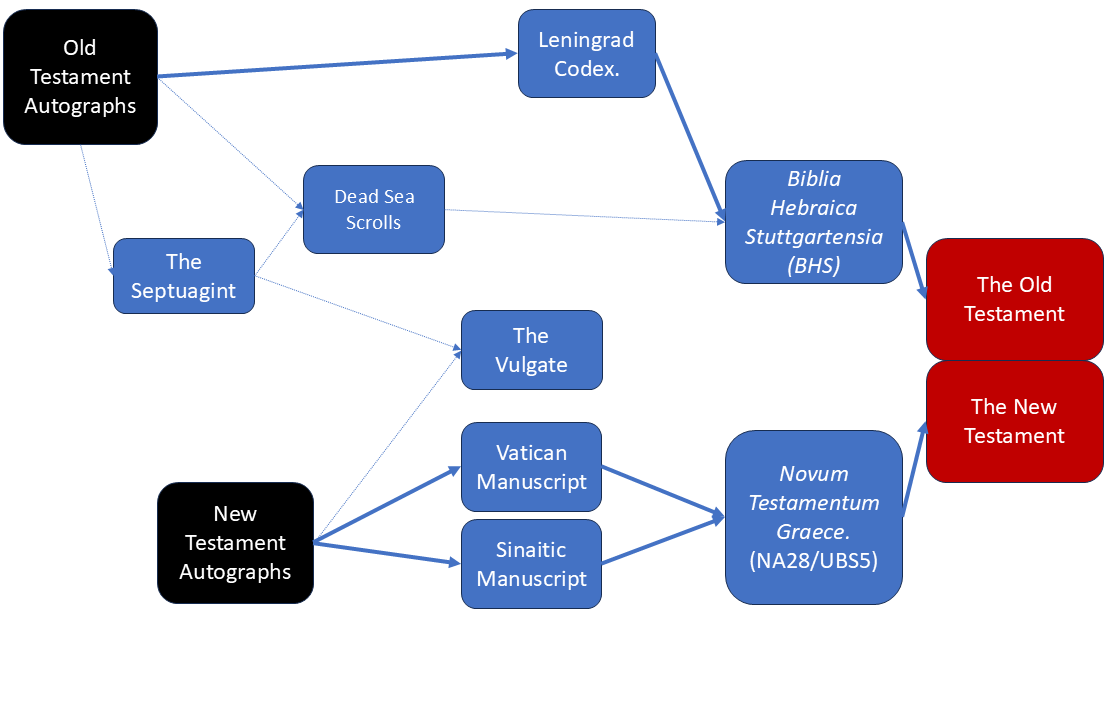
The image above shows a flowchart of the timeline from the original autographs to the modern Bible. Click it to enlarge.
The second post blog in this series examines the background and history of translating the Bible into English.