Obviously, the Bible has been translated into languages other than English. Jesus told his disciples to make disciples of all nations (Matt 28:18—20) and to be his witnesses to the ends of the earth (Acts 1:8). As contemporary missionaries continue those efforts, they need to be able to communicate with people in their language. What is the status of that translation effort? I’ve witnessed a few examples of that effort that I share below.
Overview
The Wycliffe Global Alliance coordinates the activities of over one hundred Bible translation organizations. They identify 7,396 living languages, of which 544 have no Bible translation at all. In 1999, there were 4,600 languages with no Scripture, so tremendous progress has been made in the last 25 years. There are 776 languages with a full Bible, with work in progress on 4,447 languages.

The Museum of the Bible in Washington DC has an “illumiNations” exhibit illustrating the progress being made to translate the Bible into all living languages.

Believers have translated Scriptures continuously since ancient times. Some translations of the Old Testament predate Christ. Translations continue today. Below is a snapshot of translations that have impacted me, presented in chronological order.
Aramaic
Translations date back to before the New Testament. The earliest known translations were of Hebrew into Aramaic and are known as Targums. These were spoken translations in the 6th Century BC, around the time of the Babylonian Exile, with written forms appearing by the 1st Century BC. To the untrained eye, Hebrew and Aramaic look similar.
Greek
Around 300 BC, Ptolemy II, a Greek king of Egypt, commissioned seventy-two Jewish scholars to translate the Hebrew Scriptures into Koine Greek for Alexandria’s library. This became known as the Septuagint, after the seventy, or “LXX,” which is seventy in Latin. The dispersed, Hellenized Jews embraced this translation. Many of the quotations of the Old Testament in the New Testament use the Septuagint translation. Koine Greek was the common Greek spoken around the Mediterranean at this time and is the language of the New Testament. Koine Greek, Attic Greek (used in Classical Greek literature), and modern Greek are related but distinct. Some early translations used the Septuagint as their source text, and it continues to be used as a critical source for the Old Testament.
Latin
Evidence suggests that there were various “Old Latin” (Vetus Latina) translations of parts of the Bible in the 2nd Century AD, with the Septuagint used as the source for the Old Testament. In the fourth century AD, the Roman Catholic Church commissioned Jerome to translate the Bible into Latin. His work translated directly from Hebrew texts while building upon previous work using the Septuagint, and resulted in the Vulgate, the Roman Catholic Church’s official Bible for centuries.
Other Languages Including Ethiopic
In the first few centuries AD, the Bible was translated into a few other ancient languages. One notable example is Ethiopian, also known as Ge’ez. One of the three oldest Bibles in existence is the Ethiopian Bible from 330—350 AD. This Bible includes texts not found in other Christian Bibles, illustrating the tradition’s early divergence. It includes translations of some ancient Jewish literature, including the book of Enoch, which was written in Hebrew, but no complete Hebrew copy exists.

Image from https://aleteia.org/2025/02/04/the-3-oldest-preserved-bibles-in-the-world/
Czech
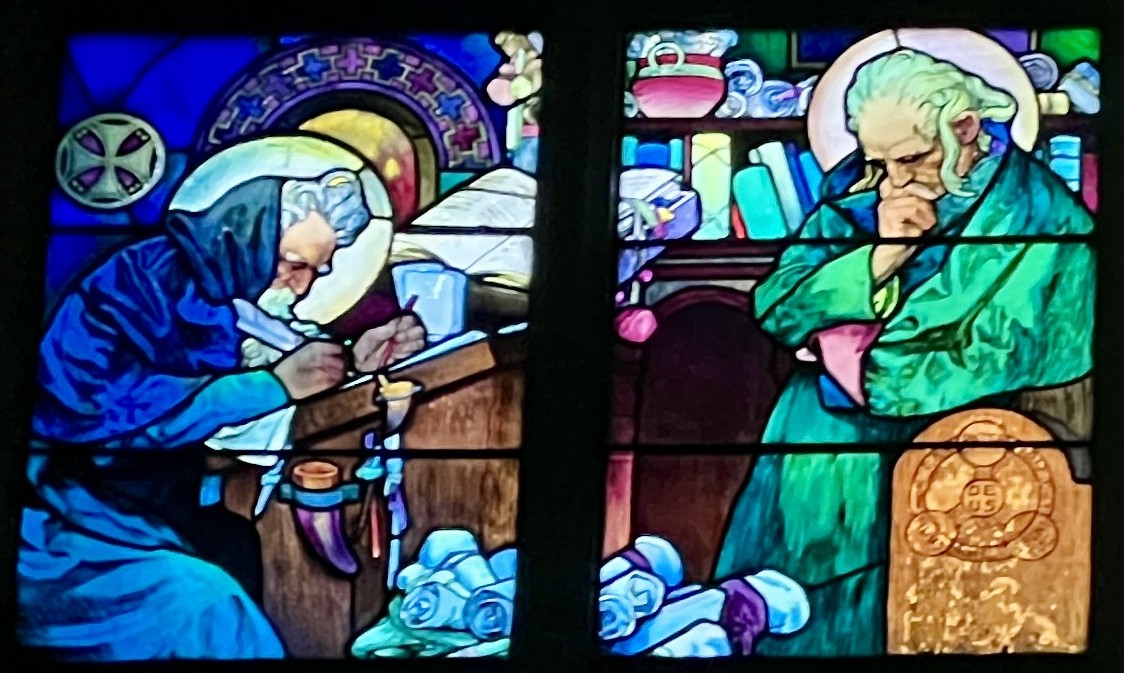
I was surprised to learn that one of the earliest Bible translations was Czech. In 865 AD, Cyril and Methodius brought Christianity to Prague from Thessaloniki. The Czechs had no written language, so Cyril created an alphabet to enable a written Bible in their language. Such a need to create a written form of a language to enable Bible translation continues today.

Cyril’s disciples evolved this language into a script that is used in over fifty languages throughout Eurasia, and was named the Cyrillic script to honor Cyril.
English
While there is evidence of translations into Old English dating back to Bede in 735 AD, Wycliffe created the first English translation of the whole Bible in 1388 from the Vulgate, with the first translation into English from the original languages performed by Tyndale around 1530. Tyndale used Erasmus’s printed Greek New Testament (see below), which led to the King James Version in 1611. On a side note, one of the earliest Bible translations was into Welsh in 1588, and it is credited with helping to save the language from dying.
Gutenberg’s Printing Press and the Fall of Constantinople
Two events in the 15th century significantly impacted Bible translation. First, in 1440, Johannes Gutenberg invented the printing press. The first book that he printed was the Vulgate.
Second, in 1453, the final major city in the Byzantine Holy Roman Empire, Constantinople (today’s Istanbul), was defeated by the Ottoman Empire. Christian scholars, with many ancient biblical texts, headed west to avoid the invading Islamists. The West’s focus on the Latin Vulgate had reduced its focus on biblical manuscripts in the original languages.
The renewed interest in the Bible in its original languages and the information revolution that the Gutenberg press enabled led to Erasmus creating the first printed edition of the Greek New Testament in 1516, the Novum Instrumentum Omne. He primarily used Byzantine texts, and his Greek New Testament complemented Hebrew Bibles that had been printed since the late 15th century. These books and the printing process gave access to the Bible in its original languages to many more translators.
German
Martin Luther completed his influential translation into German in 1534, leveraging other scholars to help with his translation from the original languages. Luther also used Erasmus’s Greek New Testament.
From Swahili to Spanish
I first saw a Bible in a non-English language during a visit to Kenya in 1992, when a market trader showed me her Swahili Bible. Since then, I have always been fascinated by how the biblical text looks in languages that use a different script from English, like Chinese or Korean. Sometimes I have been assisted by what is called a polyglot, which prints the text from two languages alongside each other. I helped a Christmas ministry distribute Bibles in English and Spanish, with the Spanish Bibles primarily for older Hispanic people who did not pick up English as easily as the youth.

Munukutuba
I was blessed to witness some pioneering Bible translation when I worked in Africa in 1997. While living in Pointe Noire, Congo, I attended a church that had been established by some missionaries from North America. While Pastor Gary would preach in French, a visiting pastor might preach in Munukutuba, the local language, also known as Kituba. I must add that I barely understood French, let alone Munukutuba, so I read my English Bible! Another Belgian missionary in town, Jean-Pierre, was working on translating the Bible into Munukutuba. A written form of the language had been created, and Jean-Pierre was working on his second New Testament book.
In 2006, the Bible Society published Ngwisani Ya Malu-Malu, which means The New Testament in Munukutuba, and it is available here. The translation, called BNT or Kituba, is available on bible.com

From https://www.bible.com/bible/4086/2CO.3.BNT?parallel=59
Kechin
Last month, our church announced that it was financially supporting the translation of the Bible into a South Asian language. The language was identified as Kechin, though this is a pseudonym to protect the translators involved, as there can be strong local resistance to such initiatives.
Arabic
Decades of study in the Middle East led Kenneth Bailey to write The Cross & the Prodigal: Luke 15 Through the Eyes of Middle Eastern Peasants. It is a fascinating insight into cultural symbolism in the narrative of the Prodigal Son, which is lost when read with Western eyes. Bailey argues that much of the first-century culture has been preserved in the Arabic way of life. In the book’s introduction, he points out that “There are more Arabic-speaking Christians in the Middle East than Jews in the entire world.” While Arabic speakers were present at Pentecost (Acts 2:11), Arabs are assumed to be Muslims, and little attention is given to Arabic translations of the Bible.
One example Bailey provides in Jesus Through Middle Eastern Eyes is the mistranslation of “inn” in Luke 2:7. Bailey explains that the word in the Arabic translation would definitely be a guest space, typically the upper room of a common village home, rather than a commercial establishment. However, I note that Bailey uses the RSV, which preserves the KJV’s usage of “inn,” while translations that started from the original languages, such as CSB and NIV, use “guest room.” The NET Bible, while using “inn,” provides detailed notes on the translation debate about this word.
Bailey’s books provide fascinating insight into how one’s culture influences one’s reading of the Scriptures, and I thoroughly recommend his books.

Other Non-Foreign Languages
The Bible Museum’s exhibits included a Bible in Braille. Wow! I have since learned that there are different forms of Braille for over 130 languages, with about 40 having a Bible in Braille. There are also over 300 distinct sign languages, with the complete Bible only in American Sign Language, and the BSL Bible Translation Project actively translating the Bible into British Sign Language. You can watch Mark’s Gospel below. I wish there were subtitles!
Other Translations
My research revealed that there are over one hundred translations of the Jehovah’s Witnesses’ English Bible, the New World Translation. This includes the first translation in American Sign Language. However, there is significant criticism about the New World Translation, with English words being chosen to reflect the denomination’s theological position rather than the original language. Also, there are concerns about the credentials of the translators, who have remained anonymous.
Reflection
The illumiNations alliance has the goal, “It’s fully expected that, in our lifetime, 100% of the world’s population will have access to a key portion of Scripture.” They aim to have some Scripture translated into all languages by 2033.
I introduced this post with Jesus’s instructions to make disciples of all nations (Matt 28:18—20) and to be his witnesses to the ends of the earth (Acts 1:8). Some translators are also motivated by Matthew 24:14, which states that the end will come after the Gospel has been proclaimed throughout the whole world. I do not have an opinion on whether translating the Bible into all languages will accelerate Jesus’s return. Nevertheless, I see the work as valuable, and I hope that you found this interesting!