“You need to take the Bible with a pinch of salt,” I explained to a new friend during the first year at my English university in 1987. I had become a convinced believer in God in my early teens, but had not been in an environment for my faith to grow. It took nearly forty years and a global pandemic to achieve a level of biblical knowledge that gave me confidence in my understanding. For some reason, God made me slow to learn, with a need for academic rigor. Below are the highlights of that forty-year journey.
– My First Bible
– Church Teaching from the Bible
– Baptism and Births
– China to COVID
– Change Creates Opportunity
– A Ph.D. in Bible Exposition
– Then What?
– Reflection
My First Bible
My family did not attend church, but my parents dropped me off at a local church’s Sunday school when I was young. England’s Christian culture had exposed me to the Bible’s stories and taught me that the book contains many good morals. I studied Mark’s Gospel for my O-level in Religious Education when I was sixteen, with a focus on knowledge of the text. I found that the biblical text was distant, from another time and another place, and I struggled to relate to it.
At university, I met a tremendous variety of people and made many new friends. One in particular encouraged growth in my faith and invited me to attend church with them. A church minister encouraged gatherings and discussions, and I was asked what I thought about the Bible. I understood that the ten commandments and parables, such as the Good Samaritan, were good things. I knew the Bible described miracles from the parting of the Red Sea to Jesus’s healings, though I had some skepticism about supernatural events, even though I knew God was real.
I responded to the minister that I took the Bible with a pinch of salt, meaning some of it was relevant, while much was less applicable in the twentieth century. I am thankful that the minister, with my friend, saw this as a great educational opportunity! I don’t remember the specifics of discussions, but I know they inspired me to buy my own Bible.

I took to heart the instruction, “read your Bible.” I’d chosen a small one, allowing it to travel with me on all of my future adventures. I used thick black tape to hold it together as the travelling took its toll. In the early nineties, multiple adventures took me to exciting destinations from Venezuela to Papua. I lived in a desert camp in the heart of Oman for three years. I read the whole book, but so much of it meant nothing, and my living environment hindered plugging into a church.

Church Teaching from the Bible
When I first came to Houston, Texas, in 1995, my desire to find friends outside of work led me to seek a church. I was only familiar with the Anglican Church from England, and of the thousands of churches in the phone book, there was only one in the whole city. Other than the Anglican Church, all that I knew was that I was not a Roman Catholic! However, there was a very large Baptist church close to where I was living, so I tried that out. I immediately found the teaching directly from the Bible to be very refreshing, but I only had a few months in Houston before work moved me to Lafayette, Lousiana.
My Bible study class’s director in Houston suggested I try out Lafayette’s First Baptist Church. The teaching was also biblical, but I struggled with adapting to some of the Louisiana culture embedded in that teaching. Also, my offshore work schedule meant that my attendance was inconsistent. I augmented Sunday morning teaching with reading a chronological Bible, yet my knowledge struggled to grow.
My job’s move to an onshore position led to the biggest change in my life, but it was not about the Bible. Regular participation in the church’s singles Bible study class allowed me to befriend Janet, who helped change my life’s direction when she married me nearly two years later.

Baptism and Births
When work transferred me to Pointe Noire in the Republic of Congo, I knew that Janet would be my wife, even though I had not yet proposed. The prospect of marriage caused me to take life more seriously. Providentially, a coworker introduced me to an evangelical, Bible-believing missionary church that met in a circus tent by the airport, led by an American family.

Language barriers meant that participating in Bible study was difficult, but I witnessed the amazing examples of missionary families leading churches and translating the Bible into the local language. Their example inspired me to take my faith more seriously and to get baptized in the bay.

After our wedding, my work moved me back to Texas. We quickly plugged into a Bible-believing church and were active in our Bible study class and volunteering. It was a great time for Bible-study-centric social gatherings, which helped us define our marriage’s direction. Greater involvement at church led to some additional Bible classes, but I never felt confident enough to teach. I facilitated some group sessions, but I was intimidated by how much Bible study teachers knew about the Bible. Two babies changed our life’s direction, and my low understanding of the Bible remained on a plateau.

China to COVID
When our youngest was just nine months old, we moved with work to Beijing, China. We immediately found a church for expatriates like ourselves and found areas that each of us could serve. After a year in China, we moved to the UK for five years. Having found a church, we got very involved in children’s ministry, which extended the plateau of my biblical learning.
In 2010, we moved back to Houston with work and returned to the large Baptist church that I had attended in 1995. Our focus remained on helping with children’s ministry, and it was a blessing to watch our kids grow in their faith.

As our kids moved out of elementary school, we took a step away from children’s ministry, enabling us to take some additional classes. The most helpful one was a short series that went through the whole Bible. This was the first time that anyone had presented to me the Bible as one interlinked narrative about Jesus. It made me hungry for more.
However, hunger to learn does not equate to learning. My work remained intense with frequent travel. I remained in awe at the biblical knowledge of our Sunday school teachers and felt resigned to always being the student, often barely understanding the details behind their teaching. While I was happy with learning from them on sporadic Sunday mornings, I passively hungered for more but could not work out how to get it.
Then COVID happened. We were in the Caribbean when everything changed, and we barely made it back into the country before the lockdowns started.

Change Creates Opportunity
On our return, my employer mandated remote working. With neither work’s intensity nor our kids’ activities filling my calendar, I suddenly had free time, but with the COVID restrictions. Perhaps I could use this for some structured Bible study? Internet searches converged on a Graduate Certificate in Biblical Studies at Liberty University. It comprised four eight-week classes, with two classes on each testament.
The uncertainty around COVID and my work made me reluctant to commit to studies for a long time. While four back-to-back classes would span over half a year, I was eager to try it out. Even if I was only able to complete one class before life’s intensity returned to pre-COVID levels, I would have learned more about the Bible, so I enrolled. Timing was very tight, as I started my application just twenty-four hours before that semester’s deadline, but I was accepted in time. The door had opened; it was meant to be!
The classes required a lot of reading and high-quality academic writing. Neither of these was my strength, as my background was engineering, but my first professor was patient, helpful, and inspiring. Each class involved reading about one quarter of the Bible, multiple dense textbooks, and writing papers in a strict format.
The goal of the classes was a survey of the whole Bible. I loved all of it! However, an essential complement to the studying was church. I needed to keep hearing the perspectives of my pastor and Bible study teachers to keep me aligned with God’s big picture. Their teachings also challenged the many new ideas that were growing in my brain as I learned more, and they helped prevent me from getting lost in academic thought.

As COVID dragged on, and having completed a couple of the classes, I wanted to continue my studies. I embraced the opportunity of rolling the Graduate Certificate classes into a twelve-class Master of Arts in Theological Studies. Building on the Graduate Certificate’s Bible survey classes, the Master’s added classes covering apologetics, church history, intercultural communication, hermeneutics, systematic theology, and an introduction to biblical languages. I loved the continued learning about the Bible from different perspectives. I remained motivated by the tangible nature of understanding the biblical text while struggling with the abstractness of theological topics.

Even when I signed up for the Master’s program, return-to-work uncertainty kept me thinking of one class at a time, and if I had to stop at any time, I would still have gained valuable biblical knowledge. However, COVID-related slowness at work continued, and I happily completed the Master’s degree. I accepted an early retirement package from work with plans to pursue a disaster relief ministry. I’d learned enough about the Bible to understand everything that my accomplished Sunday school teachers taught. I still lacked the confidence to teach, but perhaps teaching was not my calling?
A Ph.D. in Bible Exposition
My attempt to participate in disaster relief kept hitting roadblocks while the door to continuing my academic studies remained open. The logical progression for my studies was a Ph.D., but was I ready for that level of commitment?
After prayer and discussion with Janet, I started Liberty University’s Ph.D. program in Bible Exposition. Its core classes were the next logical steps in deeper Bible study, with topics around (1) Hermeneutics, i.e., how to study the Bible effectively, (2) Biblical languages, and (3) Nine seminars deeply diving into the biblical text. These classes prepared the student for their dissertation. I approached the classes like the previous courses, where my focus was on each class’s learning rather than degree completion.

I created an aggressive plan that allowed me to complete the above classes at the same time that our youngest child graduated from high school. I lacked the confidence to tackle a Ph.D.-level dissertation, and I expected that Janet and I would have developed plans once both kids were in college.
I was able to keep up with my aggressive plan and continued to thrive in the classes. Once I started the classes that dived deeply into the biblical text, I felt that my papers were “starting to join the conversation” about the topics that I addressed, which was the course’s intention. While that “conversation” was within academia, I was also encouraged by a men’s Bible study that I was part of. I had grown from being a participant to a leader. I chose topics and directed the discussions. I was able to reframe my scholarly learnings for a non-academic setting with confidence.
Appreciating that a Ph.D. was a “terminal degree” motivated me to finish. A final piece of inspiration came from one of our kids’ friends. I had affectionately been known as “Mr I”, as a respectful abbreviation of my surname, Ireland. On learning that I was pursuing a Ph.D, they exclaimed, “You’d be Dr. I!” While I don’t like using the “Dr.” label, that enthusiasm helped me choose the “I” in this website’s title, “The Bible and I.”
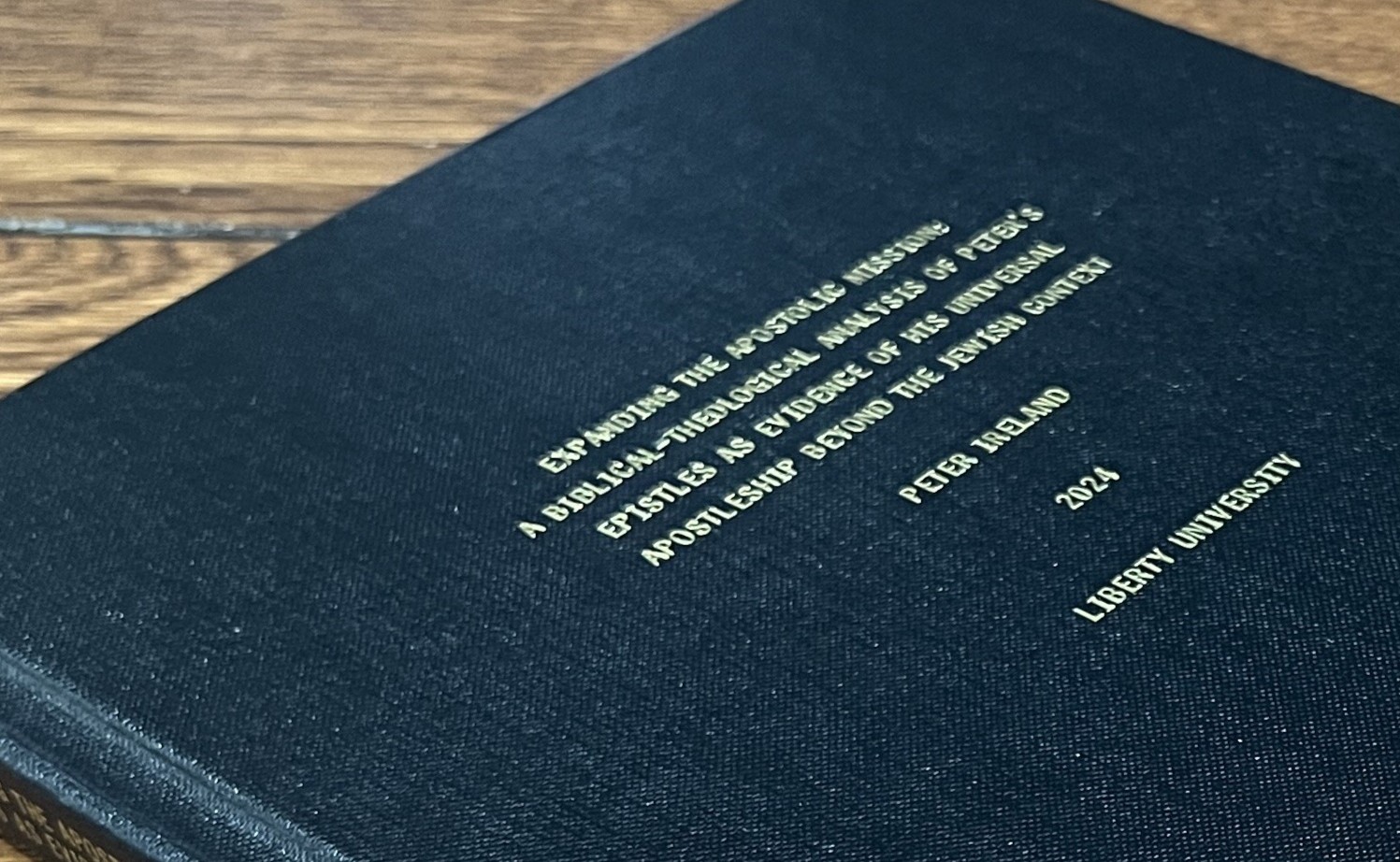
We settled our youngest child into college, and I dove into my dissertation. In parallel, I took on a significant volunteer role at our church’s school, which helped keep me sane. In summary, I successfully defended my dissertation a year later and received my doctorate in April 2024. Amazingly, I learned more in that year than in the previous two. Specifically, I learned the art of thorough research.
I wrote a blog post with details of my Ph.D. journey on my adventure blog here. You can download a copy of my dissertation here.

Then What?
Completing a Ph.D. dissertation was a relief, while it left a vacuum. Unlike most of my fellow students who were in full-time ministry and had ambitions to teach academically, I did not have a plan for what to do with my new qualification. My goal had been knowledge attainment. I was happy with achieving this goal, but felt that it was a missed opportunity not to share.
My dissertation mentor had emphasized that what I did with the degree was far more important than the letters that I could attach to my name. I have sought opportunities to teach Sunday school, but my class is already blessed with great teachers.
So I have started this blog. I want to share what I learned during my studies, from foundational biblical truths to little nuggets, as I think it can benefit others. As a minimum, the act of writing brings clarity to my own thoughts. If it is God’s intent, my words will help others with their journey of improving their knowledge of the Bible.
Reflection
The pursuit of academic degrees about the Bible was right for me at a specific time and life situation, triggered by a unique opportunity. Academic rigor suited me. Janet was very supportive, and the course flexibility allowed me to always be available for our kids. Previous attempts at deeper Bible study with our churches had stalled.
However, this was not just an academic pursuit. Active participation in a Bible-believing fellowship keeps the academic mind aligned with God’s plan for his church and for humankind through Jesus.
Leave a Reply